


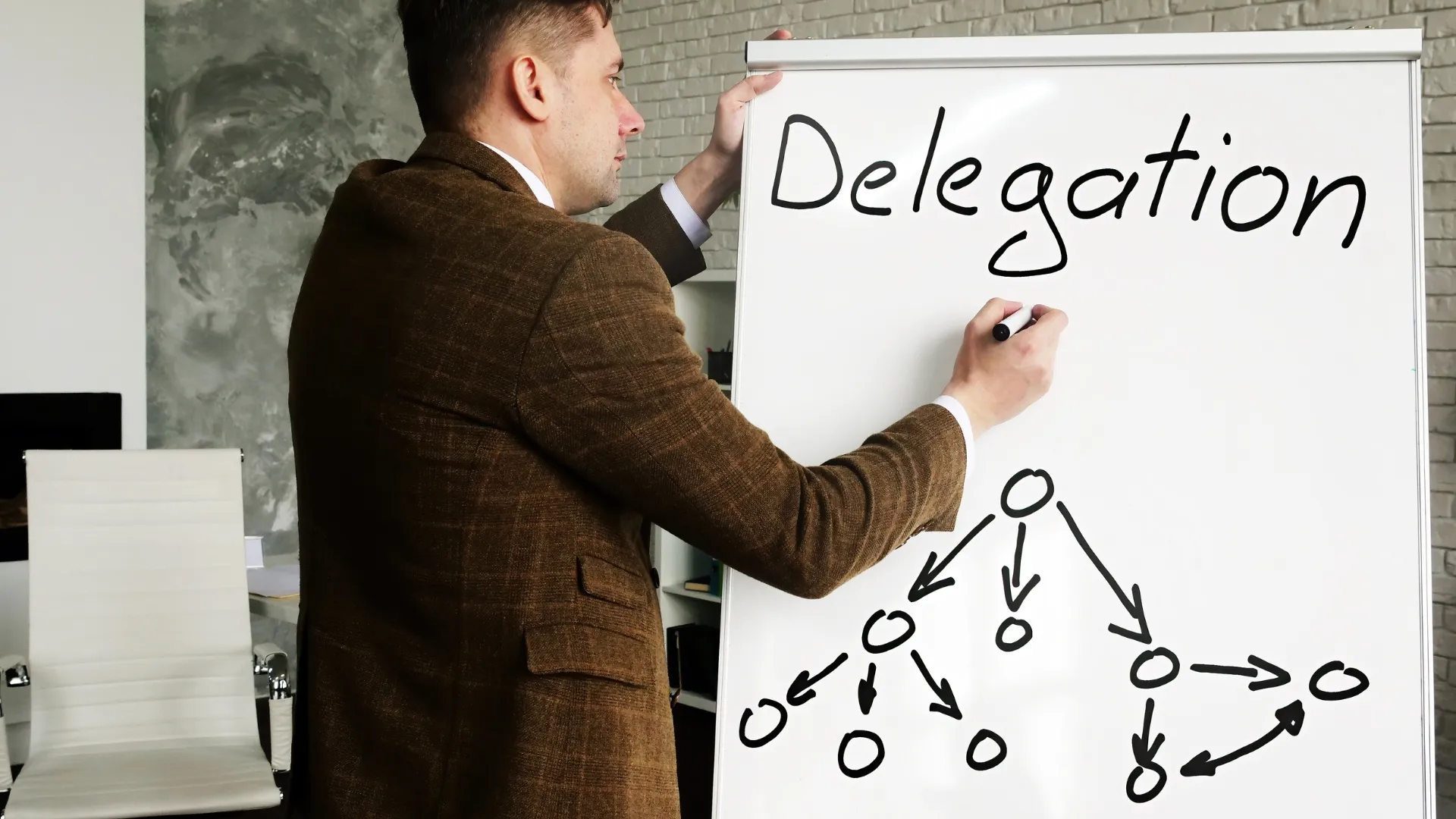
A business coach can help you delegate more effectively when the real issue is not “I need to try harder,” but “I do not have a system for handing off work.” Coaches help owners separate high-level tasks from low-level tasks, match people to outcomes, and write clear standards. The result is more owner time on growth and less time trapped in daily operations.
That matters because most leaders think they already delegate well. London Business School research associated with Professor John Hunt found that only about 30% of managers believe they delegate well, and only about one in three of those is rated as a good delegator by their team, roughly one in ten.
Delegation is also a profit skill. Gallup research on Inc. 500 CEOs found that leaders with high delegator talent generated 33% greater revenue than those with low or limited delegator talent and posted a higher three-year growth rate. For a local or small business, the same pattern shows up as fewer nights in the office and more capacity to sell, hire, and improve margins.
Key takeaways
|
Why small business owners struggle to delegate
Many business owners struggle to delegate because they built the business around themselves. Here are the common patterns:
- You can finish the job faster than you can explain it.
- Past delegation went poorly, so you took the work back “just this once.”
- Your team waits for approval because you still own every exception.
- You confuse activity with leadership: busy days feel productive even when nothing strategic moves.
- You have no written standard, so “quality” means “the way I would do it.”
That is the Owner’s Trap in practice. The business needs you for vision, key relationships, and high-stakes decisions. It should not need you to answer every email, schedule every job, rewrite every proposal, or approve every $40 purchase.
A business coach’s first job is to make that cost visible. If your time is worth $200 an hour and you spend 10 hours a week on work someone else could own, you are spending $104,000 a year of owner capacity on the wrong work.
How a business coach actually improves delegation
Business coaches help business owners improve delegation by helping them create and implement a repeatable process.
They define the owner’s real job
A coach helps you name the work only you should do: strategy, pricing architecture, key hires, culture, major customer relationships, and capital decisions. Everything else becomes a candidate for elimination, automation, or delegation.
This is how owners move from operator to leader. At Small Business Coach Associates, that shift sits inside the path from chaos and business freedom: the business becomes less dependent on the founder.
Most owners guess at how they spend time. A coach makes you log it:
- Track one week in 15- to 30-minute blocks.
- Sort every activity into keep, coach someone else to own, automate, or stop.
- Pick three handoffs for the next 14 days—not 30 “someday” tasks.
The 70% rule is a practical filter: if another person can do the work at least 70% as well as you, they are a candidate to leave your plate. Waiting for 100% is how owners stay trapped.

They teach outcome delegation, not task dumping
“Can you handle follow-up?” is not delegation. A coach rewrites the handoff so a team member owns a result:
- Weak: “Take over customer follow-up.”
- Strong: “You own follow-up on all open proposals. Every prospect gets a response within one business day. The pipeline shows next action and due date for every active opportunity.”
That single change reduces bounce-back.
They build the system around the person
Delegation fails without:
- A written SOP or checklist
- Decision rights (what they can decide without you)
- Escalation rules (when they must come back)
- A scorecard (2–5 measures, not 25)
- A review cadence (weekly, not constant interruption)
The coach’s role is to keep you from skipping those pieces because “we’re too busy this week.” Busy is the reason the system is late.
They coach the mindset that keeps work glued to you
The operational problem is usually a belief problem:
- “No one cares like I do.”
- “If I am not involved, quality will drop.”
- “It is faster if I just do it.”
- “I hired people, so why is my calendar still full?”
A coach challenges those beliefs with evidence from your own week. Faster for you today often means slower for the business forever.
They add accountability; you will not give yourself
Books explain delegation. Coaching makes you practice it in front of someone who will ask next week: “Did the scheduling handoff actually leave your inbox?” That accountability is why coaching shows up in ROI studies.
In the ICF/PwC Global Coaching Client Study, 86% of organizations recouped their coaching investment, and the median reported ROI was 7x among those who could estimate it. Those figures are not a promise for every firm, but they explain why owners hire a coach for skills they already “know.”What you should keep vs. what you should delegate
At Small Business Coach Associates, delegation is not “hand off what you hate.” It is an Employee Delegation Plan: identify the non-CEO tasks you are still doing, train someone else to own them, and put your hours on CEO-level work that raises profit and business value.
That is how you leave the Owner’s Trap and move from Chaos and Burnout toward Freedom.
Frequently Asked Questions
1. How can a business coach help me delegate more effectively?
A business coach can help you create a repeatable system for handing off work. This includes identifying the work only the owner should do, choosing tasks to eliminate, automate, or delegate, defining clear outcomes, and giving employees the SOPs, decision rights, escalation rules, scorecards, and review cadence they need to take ownership.
2. What tasks should a small business owner delegate?
Owners should delegate non-CEO tasks that keep them trapped in daily operations while keeping responsibility for areas such as strategy, pricing architecture, key hires, culture, major customer relationships, and capital decisions. A practical filter is the 70% rule: if someone can perform the work at least 70% as well as you, that task is a candidate to leave your plate.
3. Why does delegation fail for small business owners?
Delegation often fails because owners hand off tasks without handing off decisions or creating clear standards. Without written SOPs, decision rights, escalation rules, scorecards, and a review cadence, work tends to bounce back to the owner and keeps the business dependent on them.
Author
Alan Melton is an Inc. 500 founder, author, and business coach who has built, scaled, or acquired 18 companies. His early life was marked by adversity. After being kicked out at 15, he was taken in by two families who introduced him to faith, personal growth, and the principles that shaped his life and leadership.
Alan later built a transportation company trusted by the Ritz Carlton, Marriott at Sawgrass, the Jacksonville Jaguars, and Merrill Lynch. Under his leadership, the company earned a place on the Inc. 500 and won the Florida Governor’s Sterling Award for Organizational Performance Excellence.
Today, Alan leads Small Business Coach Associates, where he has coached more than 1,100 business owners. He helps owners break free from the Owner’s Trap, use the 36 Point Scorecard to find the biggest gaps in their business, and move through the 7 Stages of Business Freedom toward greater profits, stronger teams, and more freedom.
